There's a reason most fitness apps don't feel like games and most games don't transform your health. Building both at once requires combining expertises that almost never live in the same person.
What's in this update:
The 33 roles I cycle through, broken down by department
A real scenario: how 700+ monsters become a game system
Where the build actually stands right now
What's coming next, and when you'll see it
Plus one magical Star Wars Day coincidence at the end
Why This Is Built by One Person
Most fitness apps are built by tech teams who don't train. Most games are built by designers who've never coached anyone. Infitnite needs both, and that combination almost never lives in the same person.
Decades of playing games and breaking them down. A few years studying computer science and designing games. 15 years coaching warriors through real fitness goals. Combining the technical and design aspects of game development with the scientific mental, physical, and nutritional aspects of fitness mastery is what makes building the world's first Fitness Fantasy Role-Playing Game possible.
It's also why this is taking what it takes.
What That Looks Like in Practice
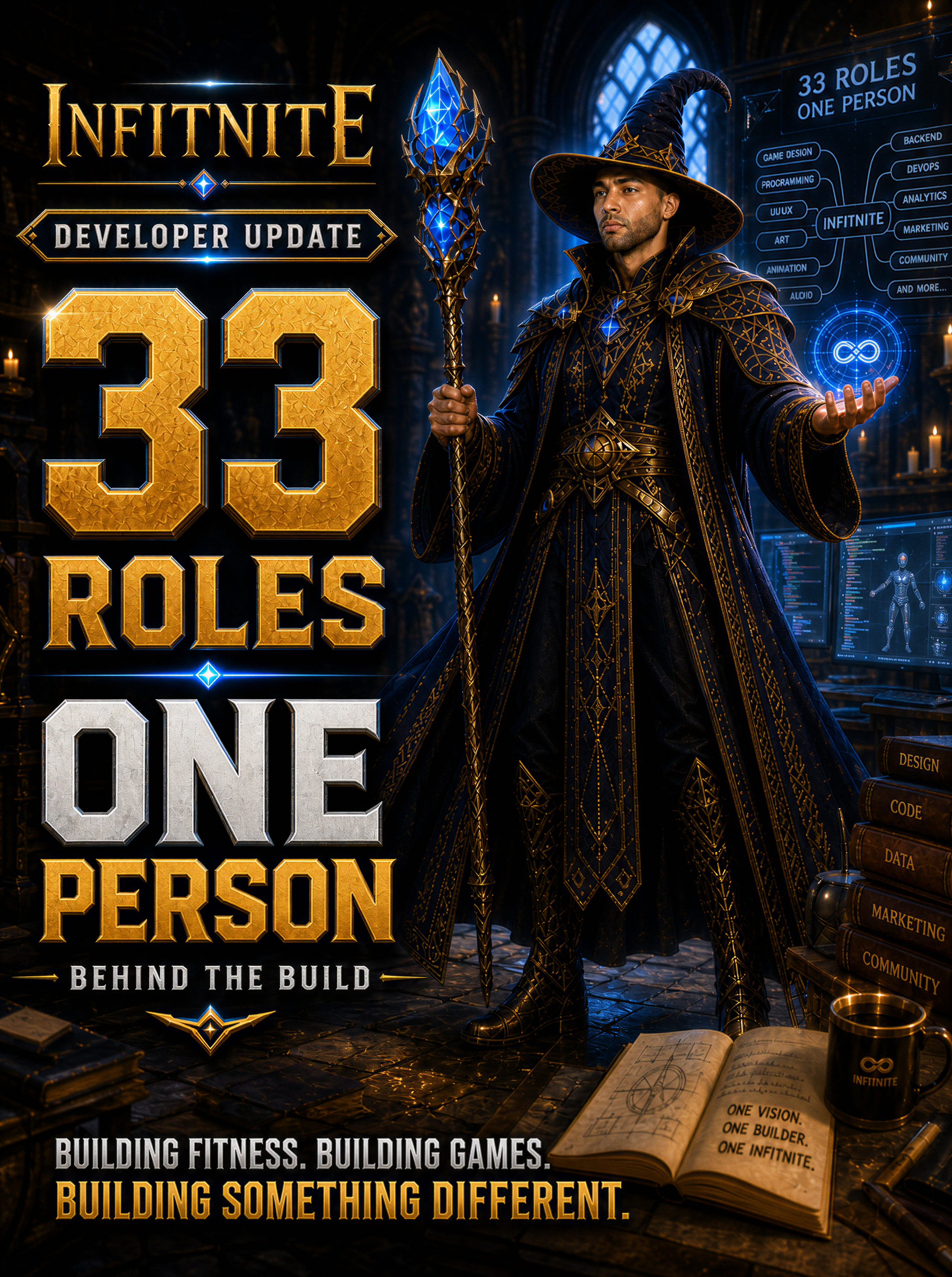
Right now I'm taking on the responsibility of about 33 different individuals. The kinds of roles that would normally be split across an entire game studio.
That was manageable when I wasn't building my own platform. Before, the platform was already built, and I balanced these roles around it. Now the platform IS the project, and the time disparity for app development is something you really just can't predict from the outside.
I'm not going into this completely fresh. Absolutely not.
The core foundation of Infitnite has been built across 5+ years of development, going back to the end of 2020. That groundwork (most of which nobody saw publicly) is the floor we're standing on now.
Inside the 33 Roles
When I say 33 roles, I mean 33 functions that would normally have a job title attached at any other game studio. Here's how they break down:
Direction & Vision (5 roles). Game director, creative director, technical director, producer, quality director. The "is this on-vision, will this scale, is this ready to ship" calls.
Engineering (6 roles). Core systems, frontend, multiplayer and social, real-world progression (the layer that bridges your actual workout activity into in-game progression), DevOps and security, build and release management.
Design & UX (6 roles). Onboarding, behavior change, liveops economy, narrative and cinematics, audio direction, concept art. The disciplines that make the game feel like a game and keep you coming back to it.
Content & Lore (4 roles). Lore writing, community management, live ops production, marketing strategy. The voice, the world, and the reason any of this lands publicly.
Analytics & Science (3 roles). Analytics engineering, sports science advising, research and development. Every fitness claim has to be defensible. Every retention decision has to be measured.
Quality & Verification (6 roles). Verification, code review, quick verification, mobile testing, interface polish review, mobile store review. Six roles that exist because shipping broken or sloppy is not an option.
Infrastructure & Compliance (2 roles). Privacy and compliance, security monitoring. The roles you only notice when they fail.
Plus utility and conditional specialists that fire when the work calls for them.
That's 33. One person, every single day.
How One System Actually Gets Built
Let me walk you through what this actually looks like in motion. Pick a system. Say, the Monster Exercise System, where the exercises in your workout get converted into monsters you fight during Combat Quests.
Here's the flow when I sit down to build it.
Game director hat first. Is this on-vision? Does turning exercises into monsters serve the north star or distract from it? If yes, green light.
Sports science advisor hat next. What's the science behind the mapping? Which exercises become which monster archetypes? How does intensity translate to difficulty? Every monster needs a defensible exercise science backbone or the whole system collapses under scrutiny.
Lore writer hat. What kind of monster does each exercise actually become? It has to fit the canon, not get slapped together. A goblin shouldn't show up where a wraith belongs.
Concept artist hat. Now I need the visual. Brief the look. Write the image generation prompts. Iterate until each monster reads instantly.
Core systems engineer hat. Schema. Combat math. Server-authoritative logic. The actual code that makes any of this function reliably.
Frontend designer hat. Now the encounter screen. The workout logging. The feedback the moment you land a hit or finish a set.
Verification, mobile tester, and interface polish hats to close it out. Does it work end-to-end? Does it run on a real device, not just a simulator? Does it pass the polish checklist?
A single system, functional and implemented, takes me 7-14 days depending on complexity. Then another two or three weeks of debugging and polish on top.
The Monster Exercise System? We're building it to hold over 700 monsters at launch.
That's just one system.
Where We Actually Are Right Now
All the foundational systems we want at launch are implemented in the app. Not just the launch experience either. The structure for future post-launch implementation is in place too.
That's a huge difference compared to most launches. We're not just thinking about the foundation. We're also laying down the stepping stones for easy post-launch updates: meaningful incremental releases, fast feedback loops with warriors, quick adjustments and improvements without breaking what's underneath.
So what's actually happening right now?
Polishing. Wiring. Asset placement. QA testing.
I know it sounds kind of boring. Nothing super juicy to reveal.
But this is the work. This is the phase that protects everything we've built so far.
What's Coming Next
The full roadmap drops this month. Closed alpha. Closed beta. Global launch. First big post-launch content. Clear timeline. No more guessing.
I've also got dozens, I mean dozens and dozens of videos queued up that break down everything we've been building. Stay tuned for those.
Once I start to reveal a little bit more, I think you'll be very surprised!
Thank You for Sticking Around
To the warriors who've been here through this build, thank you. Your patience and excitement isn't taken for granted. Not even close.
Quick update. More coming soon. Stay tuned.
P.S. Today is May the 4th. Fun side note: years ago, after all the filings and trademarks and legal hoops, Infitnite's official business registration in Washington landed approved and finalized on this exact date. Magical Star Wars Day coincidence. (The actual fifth anniversary of Infitnite's launch is coming this August. More on that with the roadmap drop.)
If this resonated, share it with a warrior who's been waiting alongside you. Your quest starts at fitnessfantasyrpg.com.
FAQ
When is Infitnite officially launching? The full roadmap drops this month with clear dates for closed alpha, closed beta, global launch, and the first big post-launch content release.
Why is development taking longer than originally planned? Several systems originally planned for post-launch were moved up into the launch experience. That extends development time, but it makes sure the launch stands on its own from day one instead of feeling like a skeleton waiting for content.
What can warriors do right now while waiting? Take the free Strength Trials at fitnessfantasyrpg.com to find out where you actually stand, or step into one of the existing Realms to start training before the unified platform goes live.
Recent Developer Updates


Update #1 covers the two weeks since global launch. Workouts survive a lost connection, Apple Health syncs when you ask, Living Quest adds cardio and hybrid runs, and every bug report in the Warrior's Circle has an answer.