
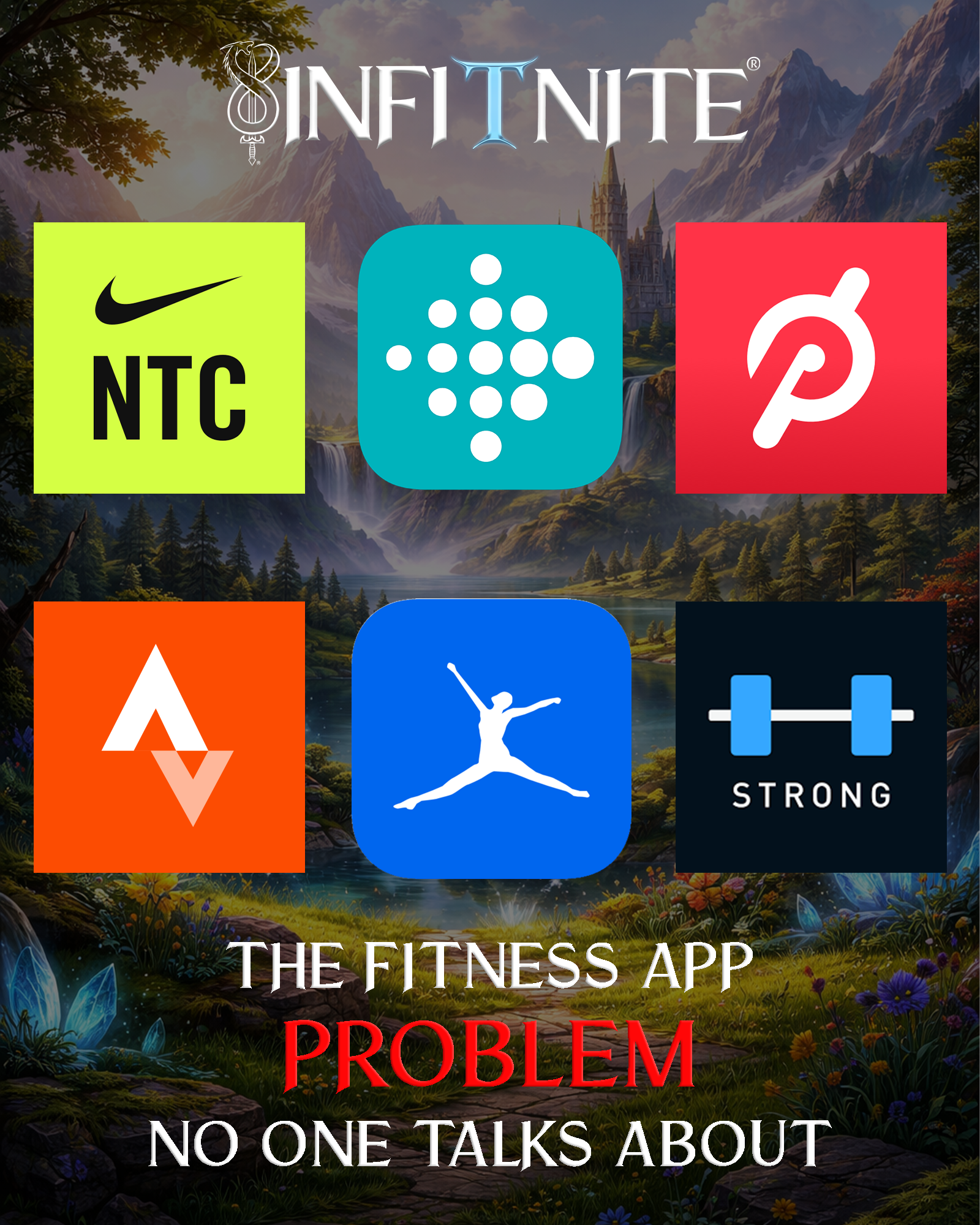
You can download the best-rated fitness app on earth and still feel stuck.
You can have the “perfect” program and still fall off by week three.
This article is for the person who keeps wondering, “Why does this keep happening to me?”
What you’ll get here is simple.
You’ll see the recurring problems hiding underneath the 1–4-star reviews, the forum rants, the quiet frustrations people don’t always know how to name. You’ll also see the deeper pattern connecting them, the part that affects your progress long before you ever miss a workout.
This article isn’t about tearing apps down.
It’s about understanding why so many people keep starting over.
This isn’t about bad apps
I’ve been using fitness apps for basically my entire career.
For years, I had ideas for what an app could be, but I didn’t have the resources, the skillsets, or the bandwidth to execute the vision the way it needed to be executed. So I did what most coaches and most people do. I relied on existing platforms and built systems around them.
And I learned something the hard way.
A lot of apps are powerful.
A lot of them are beautiful.
A lot of them are highly rated.
Some even do one thing better than everybody else.
But “highly rated” does not always mean “effective for you.”
That disconnect is the core of what we’re unpacking.
Because if fitness apps are more available than ever, and tracking tools are more advanced than ever, why are so many people still bouncing from app to app, restart to restart, year to year?
It’s not just surface-level bugs.
It’s the missing rules underneath the whole category.
The pattern beneath the complaints
When you read enough reviews, something weird happens.
Different apps.
Same feeling.
Nutrition apps. Training apps. “AI coach” apps. Community apps. Habit apps. Recovery apps.
The details change, but the pattern repeats.
And the pattern is not, “This app is trash.”
The pattern is this:
Most fitness apps are not designed as a long-term experience.
They are designed as a tool.
Tools are fine, until you’re trying to build a life.
Then you need something that can hold a journey.
So let’s name the biggest categories of pain, the ones that show up again and again. Not because we want to complain, but because you deserve to understand what keeps breaking your momentum.
The Trust Problem
Trust is the foundation of belief.
Belief is the foundation of effort.
And effort is the foundation of everything you actually want.
Here’s what keeps showing up across fitness apps, especially the big ones.
People do not just get frustrated about paying for value.
People get frustrated when the rules change mid-game.
A core feature is free. You build your habit around it. It becomes part of your loop.
Then one day it moves behind a paywall, or it becomes harder to use, or it gets buried under prompts, upsells, and friction.
That is not just a pricing decision.
That is a trust fracture.
I remember living this.
I used MyFitnessPal for years. When a key part of the tracking loop stopped feeling accessible in the same way, it did not just slow me down. It changed how I felt about the whole platform. I stopped trusting the stability of the experience, and once that happens, it is hard to invest your time again.
Because fitness is not a one-week purchase.
It’s a long-term relationship.
If an app breaks trust, it does not only lose a user. It quietly damages the user’s belief in themselves.
People start thinking, “Maybe I can’t stick to anything.”
When the real issue is that they were building a habit on shifting ground.
Here’s the line in the sand I believe in:
If something is core to the loop that helps you show up, it should not get taken away later.
You can absolutely offer premium layers.
You can absolutely charge for higher quality, personalization, speed, immersion, coaching, advanced tools.
Just do not punish loyalty by removing the foundation.
The Fragmentation Problem
This one is sneaky because it feels normal now.
One app for workouts.
One app for nutrition.
One app for steps and sleep.
One app for community.
One app for coaching.
One app for “motivation.”
Then you wonder why your head feels full.
That is cognitive overload, which is the mental cost of constantly switching contexts, remembering where you logged what, where you posted what, where you saved what, where the plan lives, where the metrics live.
The bigger issue is not inconvenience.
The bigger issue is that fragmented systems create fragmented progress.
Fitness is not a set of disconnected parts.
Training affects nutrition.
Nutrition affects sleep.
Sleep affects recovery.
Recovery affects training.
Mindset affects everything.
Community can save you on the days when discipline is shaky.
But most apps are built like silos.
This is not about stuffing every feature into one place.
It’s about making each feature matter by connecting it.
A pile of features is not a system.
A system is synergy, where what you do in one area gives you momentum in the others.
When the experience is fragmented, consistency becomes harder.
When consistency becomes harder, progress slows.
When progress slows, belief drops.
Then motivation decays.
Then you quit.
Not because you are lazy.
Because the experience was designed to leak energy.
The Intelligence Illusion
AI is exploding right now.
And I’m excited about it. But here’s the part that keeps getting missed.
AI does not replace foundation. AI amplifies foundation.
If the underlying program design is low quality, AI will not magically transform it into elite design. It will generate more of the same, faster.
That’s why so many “AI workouts” feel generic.
It is not always because the AI is bad.
It is often because the structure it is building on is flawed, rigid, or shallow.
People want adaptive.
They get reactive.
Reactive responds to the last thing you did.
Adaptive changes its approach as you change.
The future is not “more AI.”
The future is better design using AI.
AI can make good systems better.
It can also make bad systems louder.
The Progression Problem
Most apps are good at tracking.
A lot of apps are bad at progression.
And I don’t just mean sets, reps, and weight.
I mean the feeling of moving forward.
Because tracking progress is not the same as feeling progress.
If your experience is just logging and streaks, you can be doing a lot and still feel like nothing is changing. That’s when people start thinking, “What’s the point?”
Humans commit to journeys, not spreadsheets.
You want milestones that mean something.
You want a sense of mastery.
You want to feel the arc of who you are becoming.
In good stories, the hero changes.
That’s not fluff.
That’s psychology.
When fitness has no narrative, quitting feels small.
When fitness is part of your story, quitting feels personal.
You are the hero of your own fitness story.
Not as a quote.
As a design principle.
The Motivation Decay Problem
Most people don’t fail because they lack information.
They fail because they can’t stay engaged long enough for the information to matter.
That’s adherence.
And adherence is not willpower.
It’s design.
If the plan is too rigid, adherence drops.
If difficulty is miscalibrated, adherence drops.
If feedback is missing, adherence drops.
If progress feels invisible, adherence drops.
If the experience punishes you for being human, adherence drops.
Many apps accidentally create negative reinforcement loops.
Miss a day.
Lose a streak.
Feel behind.
Avoid the app.
That’s the opposite of what people need.
I believe in positive reinforcement.
Effort should feel rewarded.
Consistency should feel encouraged.
Every intentional action should feel like it counts.
Because when progress feels tangible, you show up again.
The deeper problem revealed
Here’s the part no one wants to admit.
Even the good apps are often built to measure you, not to carry you.
They track.
They log.
They remind.
But they don’t hold you through the messy middle, where transformation actually happens.
A fitness experience that only works when life is perfect isn’t a fitness experience.
It’s a fantasy.
And fantasy isn’t the problem. Escapism is.
The right kind of fantasy doesn’t ignore reality, it reframes it.
It gives people a story strong enough to carry them through the messy middle.
A fitness experience that only works when life is perfect avoids reality.
A fitness experience that works because life isn’t perfect helps you transform within it.
The line in the sand
This is belief, not marketing.
We don’t believe in taking away core functionality.
We don’t believe fitness should feel disconnected.
We don’t believe progress should feel invisible.
We don’t believe motivation should rely on guilt or anxiety.
We believe in progressive value.
Better outcomes and better inputs over time.
More clarity. More support. More trust.
If you invest your time and effort into a platform, it should feel like the platform is investing back into you.
Where we’re heading
The new Infitnite experience is moving fast.
Core loops are in place.
Polishing is underway.
Beta is on track for January.
But this isn’t the solutions article.
This is the foundation.
Each problem deserves its own deep dive. One that respects nuance. One that solves the problem without creating a new one.
Your next quest
If this resonated, here are three simple next moves.
Level One:
Pick one app you use right now and write down the one thing it does that quietly drains your motivation. Name it.
Level Two:
Share this article with someone who restarts every January and ask which section hit hardest.
Level Three:
Recent Developer Updates




New Avatars, two-way workout combat, a new beginning, expanded skills, and a refreshed world. Explore the changes and player-requested fixes in Update 2.